Negative Equity Trade-In: How It Works and Your Options
Yes, you can trade in a car when you owe more than it is worth. The dealer pays off your old loan, and the shortfall is either covered by cash you bring or added to your next auto loan. Which path fits depends on the numbers, so this guide shows you how to find them, what each option does to your payment, and what to check in the paperwork before you sign.
TL;DR
- Negative equity is the gap between what you owe (your payoff amount) and what the car is worth. Subtract value from payoff to find it.
- A dealer can roll that gap into a new loan, which makes the new loan larger and more expensive over time.
- A down payment, a shorter term or a lower-priced vehicle all reduce how much you carry forward.
- Read the buyer's order and the contract line by line, and confirm your old loan was paid off afterward.
- Our finance team at McFarland Hyundai can walk through the numbers with you before you pick a car.
What negative equity means on a trade-in
Equity is simply your car's value minus what you still owe. When the result is a positive number, you have equity you can put toward your next vehicle. When it is negative, you are "upside down," and Experian explains that the same subtraction tells you which side you are on.
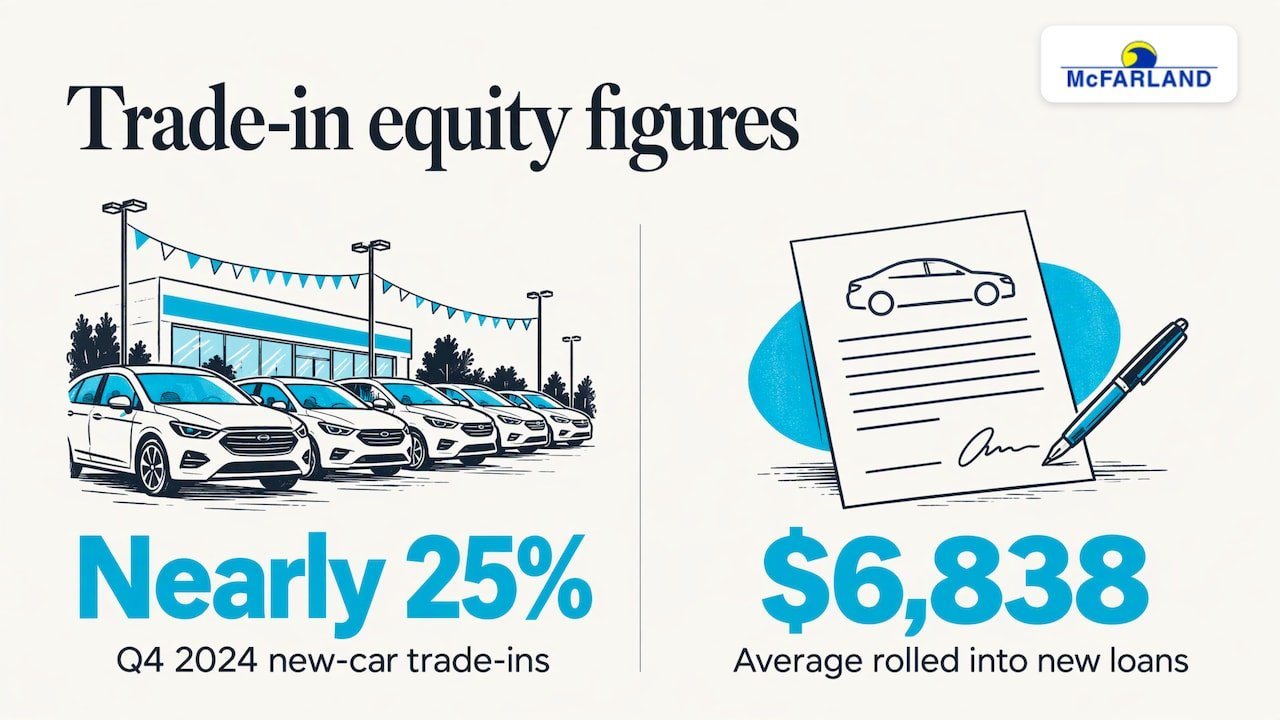
This is common. Experian reports that nearly 25% of trade-ins toward new car purchases in the fourth quarter of 2024 had negative equity, with the average amount rolled into new loans reaching a record $6,838, citing Edmunds data. If you are in that position, you are far from alone, and dealers handle it every day.
How to calculate your negative equity
You need two numbers: your payoff amount and your car's trade-in value.
Step 1: Get your payoff amount
Call your lender and ask for the payoff, not just the balance on your statement. The CFPB notes that the payoff can differ from the statement balance because of how interest is calculated, late fees or other charges. Ask what date the payoff quote is good through, since interest keeps adding up until the loan is paid. The payoff, not the statement balance, is the number used to settle the old loan.
Step 2: Find your trade-in value
The CFPB suggests researching value through Consumer Reports, Edmunds, Kelley Blue Book and NADA Guides before you decide. You can also start with our online trade-in appraisal, then bring the car to North Hampton so we can look at its actual condition.
Step 3: Subtract
Payoff minus value equals your equity. Caribou gives this example: a $22,000 payoff on a car valued at $18,000 means $4,000 of negative equity.
One detail can change the picture. Experian points out that the type of sale matters. A car with a $12,000 trade-in value and a $14,500 private-party value, with $13,000 owed, shows $1,000 of negative equity as a trade-in but $1,500 of positive equity in a private sale. Trading in is faster and simpler because the dealer handles the payoff and paperwork, so many owners accept the difference for the convenience.
What the dealer does with the amount you still owe
Here is the usual sequence:
- You agree on the price of the new vehicle and the value of your trade.
- The dealer prepares a buyer's order showing the new car's price, the trade-in value and the negative equity to be covered. Look for a line labeled net trade-in or trade difference, which is where your shortfall appears.
- The finance office prepares the retail installment sale contract.
- The dealer takes your trade and sends the payoff to your old lender. The CFPB suggests waiting a week, then checking with the old lender that the loan was paid off.
The WSJ gives a clear example: you trade in a car worth $10,000 but owe $15,000, and you want a $25,000 vehicle. The dealer might offer a $30,000 loan to cover both the new car and the negative equity.
Will a lender approve it?
Lenders look at loan-to-value, or LTV, the loan amount compared with the vehicle's value. The WSJ reports that limits could be 100% of the car's value or more, and some lenders allow 125% to 130%, which is what makes rolling over negative equity possible. Anything above the lender's limit is paid in cash. Our finance department can tell you where your deal lands once your numbers are in front of us.
Your options, compared
| Option | What happens | Effect on the new loan |
|---|---|---|
| Roll it into the new loan | Shortfall is added to the amount financed | Larger loan, higher payment or longer term |
| Pay the gap with cash | You cover the difference at signing | New loan covers only the new vehicle |
| Apply a down payment | Down payment goes toward the shortfall first | Smaller amount financed |
| Choose a lower-priced vehicle | Less new-car cost on top of the carried balance | Smaller loan overall |
| Choose a shorter term | Higher monthly payment, less interest | Lower total interest cost |
Using a down payment
The WSJ shows how this works: with $5,000 saved, you apply it to the negative equity and finance $25,000 instead of $30,000 in the earlier example. Even a partial down payment shrinks what you carry forward.
Choosing the right vehicle and term
Chase recommends considering a less expensive vehicle, picking a financing period carefully since shorter terms reduce total interest, and using an auto loan calculator to estimate a payment that includes both your current payoff and the new vehicle's cost. If you want a lower purchase price, our used cars under $20k and our wholesale outlet are good places to start. The outlet sells inspected trade-ins at wholesale pricing, including higher-mileage cars, and outlet cars can be financed. Every used car we sell gets an inspection, an oil change, a full detail and a full tank of gas.
What rolling negative equity does to your new loan
Rolling the balance forward is a legitimate tool, and it helps to know exactly what it changes. The CFPB says it will make the new auto loan more expensive.
The agency's June 2024 report on negative equity in auto lending puts numbers on it:
- The average loan-to-value ratio for accounts that financed negative equity was 119.3 percent, compared with 88.9 percent for accounts with a positive trade-in.
- The average payment-to-income ratio for those consumers was 9.8%, compared with 7.7% for consumers with a positive trade-in balance.
The same report found that between 2018 and 2022, 11.6% of all vehicle loans in its dataset included negative equity, and that borrowers who financed it were more than twice as likely as those with a positive trade-in to have the account assigned to repossession within two years.
The practical takeaway is to build a payment you are comfortable with from day one. Run the monthly figure with your payoff included, check it against your budget, and adjust the down payment, term or vehicle until it fits. That is a conversation we are glad to have, and it is why we like to see your numbers before you pick a car. You can get pre-qualified online first.
What to check in your paperwork
The details in the contract matter as much as the monthly payment.
- Read the buyer's order. Find the trade-in allowance, the payoff and the negative equity lines, and make sure each number matches what you agreed to. New Hampshire has no general sales tax, so there is no sales tax line to untangle on a New Hampshire purchase.
- Watch for "we'll pay it off" promises. The CFPB advises that if a dealer says it will pay off your negative equity, you should make sure it is not included in your new financing or final loan contract. Read everything and sign only when you understand the terms.
- Confirm financing is final before you drive away. Sometimes a buyer takes the car home before the financing is finalized, often called spot delivery. That is riskier with a trade-in, because your old car may already be gone if the deal changes. Ask whether your financing is final and approved before you leave.
- Verify the payoff. The CFPB recommends waiting one week after finalizing the new loan, then contacting your old lender to confirm it was paid off. If it was not, contact the new lender, and after reasonable efforts you can submit a complaint.
Trading in two cars with negative equity
This comes up when a household owns two financed vehicles and wants to replace both, or consolidate to one. The mechanics are the same for each car: each has its own payoff, its own value and its own shortfall. Carrying both shortfalls into one new loan stacks them, so the amount financed and the loan-to-value ratio climb quickly, and the lender's limit becomes the deciding factor.
We do not want to promise an outcome without seeing the numbers. Bring both payoff letters and we can look at each trade separately, then see whether one at a time, a down payment or a lower-priced vehicle gets you to a payment that works.
Our perspective
Most people who come to us with negative equity are worried they will be judged for it. They should not be. Loan terms are long, cars lose value fast, and plenty of careful buyers end up owing more than their car is worth.
Our approach is to put every number on the table first: your payoff, an honest appraisal, and what each financing structure does to your payment. Our finance team builds options around your situation rather than a single answer.
If a lower-priced used car or a wholesale outlet car keeps the amount financed lower, we will show you that. If a down payment makes more sense, we will show you that too. You decide, and you should leave understanding every line of the contract.
McFarland
Frequently asked questions
Can I trade in a car with negative equity?
Yes. The dealer pays off your loan, and the shortfall is either paid in cash or added to the new loan. The CFPB notes that adding it makes the new loan more expensive, so compare the payment both ways.
How do I get rid of negative equity without adding to my debt?
Pay the difference in cash or apply a down payment toward it at signing. Choosing a lower-priced vehicle and a shorter term also reduces what you finance. Your equity improves as you pay down the loan, too.
How much negative equity can I roll into a new loan?
It depends on the lender's loan-to-value limit. The WSJ reports limits of 100% of the car's value or more, with some lenders allowing 125% to 130%. Anything above the limit has to be paid in cash.
Is it a good idea to trade in two cars with negative equity?
It depends on the combined shortfall and the lender's loan-to-value limit. Each car carries its own gap, and both add to the new loan if rolled over. Share both payoff amounts with our finance team and we will look at the options.
How do I make sure my old loan was paid off?
The CFPB suggests waiting one week after you finalize the new loan, then contacting your old lender. If it was not paid, contact the new lender, and if that fails you can file a complaint with the FTC or the CFPB.
Sources
- Experian
- Consumer Financial Protection Bureau
- Caribou
- The Wall Street Journal
- Chase
- Consumer Financial Protection Bureau
- New Hampshire Department of Revenue Administration
See it in person in North Hampton
McFarland Hyundai is at 177 Lafayette Rd (Route 1) in North Hampton, NH, a few minutes off I-95 and Route 101. Call (603) 697-7389 or start with our online trade-in appraisal. For current offers, check our vehicle specials page.