First-Time Car Buyer Loans: How to Finance Your First Car
The best first car loan is one you have sized to your budget, compared against at least two lenders and matched to a short enough term that the interest stays small. You don't need perfect credit or a long history to get there. At McFarland Hyundai in North Hampton, NH, our finance team works with first-time buyers, and you can get pre-qualified for an auto loan before you ever sit down with a salesperson.
TL;DR
- Set a budget that covers the whole cost of owning the car, not just the monthly payment.
- There is no fixed minimum credit score for an auto loan, but a score around 661 or higher usually brings better terms.
- Put down at least 10%, ideally 15% to 20%, and keep the term at five years or less.
- Get preapproved and compare APR, term and total cost before you choose a car.
- Taxes, title and registration fees are fixed, but many dealer fees, add-ons and the trade-in value can be negotiated.
Start with a budget, not a monthly payment
A payment that looks small can hide a large bill. The Consumer Financial Protection Bureau (CFPB) tells buyers to set a budget before shopping and to count taxes, title and dealer fees, insurance, gas, registration, maintenance and repairs. It also says to look at the total cost of financing, because longer terms mean more interest and a higher risk of owing more than the car is worth.
The CFPB describes the true cost of a car as the up-front cost plus monthly expenses, minus any trade-in or down payment.
Two rules of thumb help you set a ceiling:
- Fidelity suggests keeping all monthly car costs to 15% or less of your after-tax income. On $5,000 of monthly take-home pay, that is $750 for payment, gas, insurance and maintenance together. After average gas and insurance costs and a $100 maintenance budget, about $252 is left for the payment.
- A credit union's 20/4/10 guideline says to put 20% down, finance no more than four years and keep vehicle costs at or below 10% of gross monthly income.
Pick whichever fits your income, then work backward to a price range. If you want a starting point, our used cars under $15k, under $20k and under $25k pages let you shop by price. Every used car we sell gets an inspection, an oil change, a full detail and a full tank of gas. If you want to stretch a first-car budget further, our wholesale outlet sells inspected trade-ins at wholesale pricing, often good first cars or higher-mileage cars that are still in good shape, and outlet cars can be financed.
What credit score do you need?
No law sets a minimum score. Experian notes there is no minimum credit score required for an auto loan, though a VantageScore of 661 or above generally improves your chances of favorable terms, and a FICO Score of 670 or higher counts as good. LendingTree says most approved borrowers have scores of 661 or higher, and some lenders don't require a specific score at all.
A first-time buyer often has a thin file rather than a bad one. That means few or no accounts on your credit report. Lenders have less to judge you on, so your income, job history and down payment carry more weight.
If you have little or no credit history
Three routes come up most often:
- A cosigner. Someone with established credit signs with you. Experian points out the loan then appears on the cosigner's credit report and can affect their score and debt-to-income ratio, so on-time payments matter to both of you.
- A larger down payment. Less borrowed means less risk for the lender.
- Building credit first. A credit union guide says that six to twelve months of building credit can make a real difference. A secured credit card with on-time payments and utilization under 30% is one of the simplest ways to start.
When your credit is limited or has had trouble, ask us about second chance financing. Our first-time buyer page has more on buying your first car with us.
How down payment, APR and term shape what you pay
APR, the annual percentage rate, is the yearly cost of borrowing including interest and certain fees. The loan term is how many months you take to repay. Together with your down payment, they decide both the monthly payment and the total you hand over.
Down payment
PNC says first-time buyers should generally be able to put at least 10% of the price down, which is $3,000 on a $30,000 car. Consumer Reports' autos reporter recommends at least 15%, and 20% to 25% if you can. The CFPB's auto loan worksheet puts it plainly: a larger down payment will lower the total cost of your loan, because you borrow less and pay interest on less.
Term
A longer term lowers the payment and raises the cost. The CFPB's sample table for a $20,000 loan at 4.75% shows the trade-off:
| Term | Monthly payment | Total interest |
|---|---|---|
| 36 months | $597 | $1,498 |
| 60 months | $375 | $2,508 |
| 72 months | $320 | $3,024 |
That table comes from the CFPB's loan comparison page, which also notes that some financial experts recommend loans of five years or less.
The gap widens on longer loans. Experian shows that on a $36,000 loan at 6.37% APR, a 96-month term costs $480 a month but $10,042 in interest, which is $6,398 more than the 36-month term at $1,101 a month. Consumer Reports' reporter advises steering clear of 84- and 96-month loans.
Rate changes matter too. On a $20,000, five-year loan, Chase's example puts the total cost at $22,645.48 at 5% APR and $22,921.39 at 5.5%. Rates move with the market and your credit, so use a live quote rather than any published example as your benchmark.
Get preapproved and compare offers
Preapproval means a lender tells you how much it will lend and at roughly what rate before you choose a car. The CFPB recommends getting one from a bank, credit union or other lender before shopping. You'll need your name, Social Security number or ITIN, date of birth, addresses, employment history, income and details of current debts, as the CFPB's step-by-step guide lays out.
Shopping around does not wreck your score. The CFPB says auto loan inquiries made within a 14- to 45-day window count as one inquiry. Compare each offer on the same four things: loan amount, APR, loan length and monthly payment. Consumer Reports advises collecting at least two preapprovals.
The same CFPB page explains that a dealer-arranged rate can include a markup over the lender's buy rate, which is why a comparison offer in hand strengthens your position. Our auto financing page explains how we help buyers find financing tailored to their situation, and our credit application takes you through the next step.
From application to signing: the steps
- Check your credit reports and score. Know where you stand before a lender tells you.
- Set your budget and ceiling. Use the percentage rules above.
- Save your down payment. Aim for 10% at minimum.
- Get preapproved and pre-qualified. Gather your documents and compare at least two offers on APR, term and total cost. With us, pre-qualifying online is the way to start.
- Choose the car. Stay inside the amount you were approved for, and schedule a test drive.
- Negotiate the right things. The CFPB lists what you can negotiate: trade-in value, down payment, APR, loan length, any prepayment penalty, optional add-ons such as extended warranties, GAP insurance or window tinting, and dealer fees for preparation, delivery or paperwork. Taxes, title and registration fees are not negotiable.
- Read the contract before signing. Match the APR, term, amount financed and add-ons to what you agreed. Ask us to explain any line you don't understand.
Avoid buy-here-pay-here lots as a first choice. Experian warns these loans often skip the credit check but can be very expensive, and the dealer typically doesn't report your on-time payments to the credit bureaus, so they don't help you build credit.
New, used or hybrid: what to finance
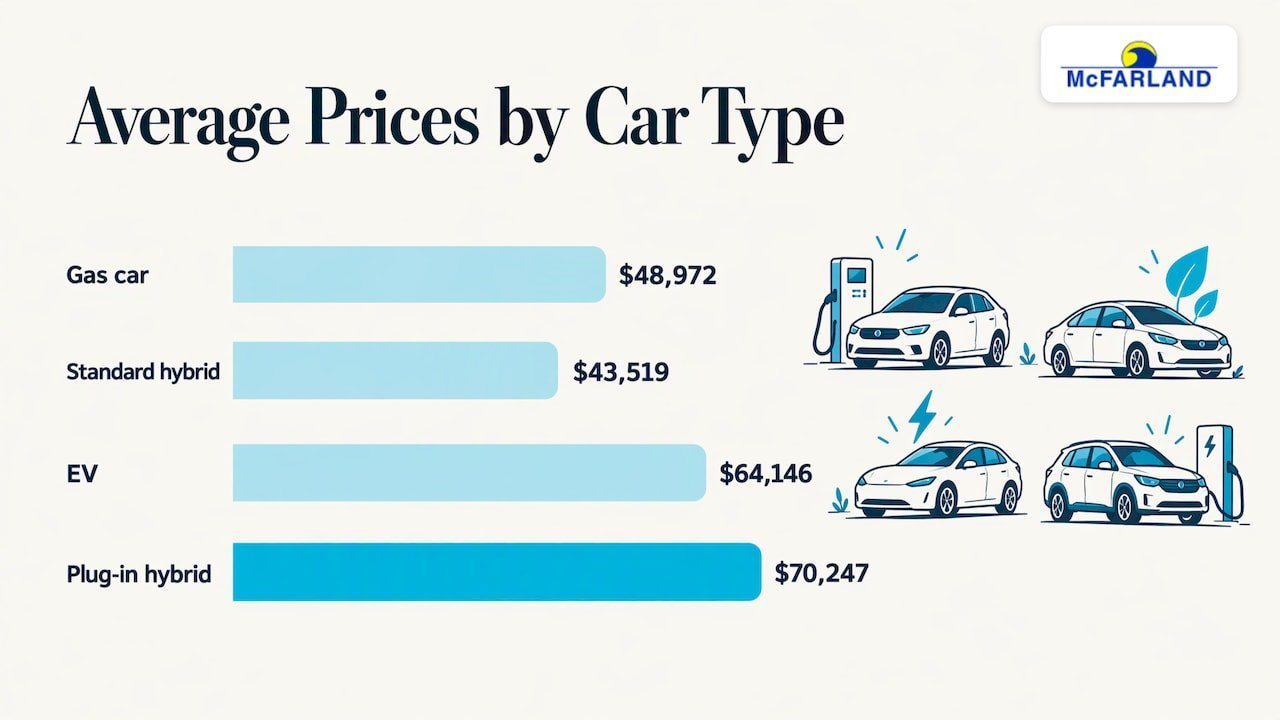
The car type changes the size of the loan. In October 2025, Edmunds data reported by AAA showed average prices before most incentives of $48,972 for a gas car, $43,519 for a standard hybrid, $64,146 for an EV and $70,247 for a plug-in hybrid. The same article reports that Consumer Reports found hybrids have 15% fewer problems than gas-only cars, and that a hybrid usually recoups its higher upfront cost in fuel savings within two to three years.
The federal EV tax credit is not available for vehicles acquired after September 30, 2025, per the IRS, so plan your budget without it. If efficiency matters to you, see our Hyundai hybrid, plug-in hybrid and electric vehicles. Certified pre-owned Hyundais come with factory-backed warranty coverage, which can make a used purchase easier to budget.
Our perspective
Most first-time buyers tell us the same thing: they want to understand the numbers before they talk about a car. We think that is the right order.
Our team explains the price, the APR, the term and the total cost in plain words, and we help match financing to your situation rather than the other way around.
If you've never had an auto loan, Hyundai Motor Finance also has a First-Time Buyer program on a new Elantra, Kona or Venue, through March 31, 2027, subject to credit approval.
Once you drive off, the car still needs care. Our Hyundai-trained technicians use genuine Hyundai parts, so the same place that helped you finance the car can keep it running well.
McFarland
Frequently asked questions
What credit score do I need for a first-time car loan?
There is no set minimum. Experian says a VantageScore of 661 or above generally improves your chances of favorable terms, and a FICO Score of 670 or higher is considered good. With a thin file, a cosigner or a larger down payment can help.
How much should I put down on my first car?
A common floor is 10% of the price, which is $3,000 on a $30,000 car, per PNC. A Consumer Reports autos reporter recommends at least 15%, and 20% to 25% if you can. More down means a smaller loan and less total interest.
What loan term is best for a first car?
The CFPB notes that some experts recommend five years or less. Shorter terms cost more per month but much less in interest. In the CFPB's $20,000 example at 4.75%, 60 months costs $2,508 in interest versus $3,024 over 72 months.
Will shopping for loans hurt my credit?
Not if you do it quickly. The CFPB says auto loan inquiries within a 14- to 45-day window count as a single inquiry, so you can compare lenders in a short stretch.
Can I finance a lower-priced first car from your wholesale outlet?
Yes. Our wholesale outlet sells inspected trade-ins at wholesale pricing, often good first cars or higher-mileage cars still in good condition, and outlet cars can be financed. Each one gets an inspection, an oil change, a full detail and a full tank of gas before pickup.
Sources
- Experian
- LendingTree
- Fidelity
- FLCU
- PNC
- The Wall Street Journal
- Consumer Financial Protection Bureau
- Consumer Financial Protection Bureau
- Experian
- Chase
- Consumer Financial Protection Bureau
- Consumer Financial Protection Bureau
- Consumer Financial Protection Bureau
- Experian
- AAA
- IRS
See it in person in North Hampton
McFarland Hyundai is at 177 Lafayette Rd (Route 1) in North Hampton, NH, a few minutes off I-95 and Route 101. Call (603) 697-7389 or start with our wholesale outlet for inspected first cars that can be financed. For current offers, check our vehicle specials page.